BACK
7 Billion Voice Notes are Sent daily yet No-one Wants to Listen
Redesigning the voice note experience inside WhatsApp for people who receive them
uX research
Mixed Methods
Interaction Design
What I Did
01.
Mixed-methods research across 43 survey respondents, 13 semi-structured interviews, and thematic analysis of 124 forum posts
02.
Six-theme synthesis through affinity mapping and grounded coding across three parallel data tracks
03.
Identification of a core asymmetry: zero friction for senders, all friction inherited by receivers
04.
High-fidelity prototype built natively inside WhatsApp's existing design system in Figma
05.
SUS evaluation across 14 participants scoring against the "Good" usability threshold
Overview
Someone sends you a 3-minute voice note. You see it. You know it's there. And you leave it.
Not because you don't care. Not because you're busy. Just because opening it feels like a commitment. You need quiet, or earphones, or two minutes you don't currently have. So you'll do it later. Later becomes never.
That gap, sitting between received and ignored, is what I spent two months trying to understand. WhatsApp sends 7 billion voice notes a day. A feature that popular shouldn't be this divisive. Something structural was broken, and it wasn't on the sending end.
Outcome
43
Survey respondents across three branching user states
6
Themes synthesised across every data source, for thematic analysis
1
Core asymmetry identified
79.1
SUS score, comfortably in the "Good" range, approaching "Excellent"
01.
The Question Behind the Question
The approach
WhatsApp has 7 billion voice notes sent daily. That number should make voice notes a success story. But spend five minutes watching real people use them and a different picture forms: some users swear by them, others actively avoid receiving them, even from people they love.
The question wasn't whether people use voice notes. It was why a feature this popular still polarises users so sharply. My hypothesis going in: there is a structural friction on the receiving end. Sending is effortless. Listening is anything but. The research either confirms that or breaks it.
02.
Three Methods, Because One Wouldn't Be Enough
THE RESEARCH
Surveys with 43 respondents gave me the behavioural baseline, structured as a branching instrument across three user states so I wasn't forcing a single lens onto fundamentally different relationships with the feature. Semi-structured interviews with 13 participants went deeper through scenario-driven prompts: walk me through the last time you received a long voice note, what actually happened next. And thematic analysis of 124 forum posts gave me what the other two couldn't: unfiltered honesty. Reddit, Medium, Tumblr. People confessing to habits they'd never admit in a research setting. I filtered those 124 down to 73 usable responses using six exclusion criteria, coded for 15 recurring ideas, and collapsed them into 6 themes.
03.
Six Themes, One Core Insight
THE FINDING
Six themes emerged consistently across every data source: Findability (information inside a voice note is practically irretrievable without replaying the whole thing), Attention Burden (40 to 45 percent of respondents regularly postponed long voice notes; 10 to 15 percent skipped them entirely), Context Misfit (the receiver walks in blind every time, with no preview, no urgency signal, no way to gauge what they're committing to), Relational Value (warmth, tone, presence — where voice notes genuinely win, especially across distance), Special Use Cases (driving, cooking, motor difficulty, accessibility needs), and Environment (background noise, privacy, colleagues nearby, whether earphones are in reach). But the insight that reframed everything was simpler than any of them: users don't reject voice notes. They reject the lack of control over when and how they consume them.
04.
Six Decisions, Each Earned
the design
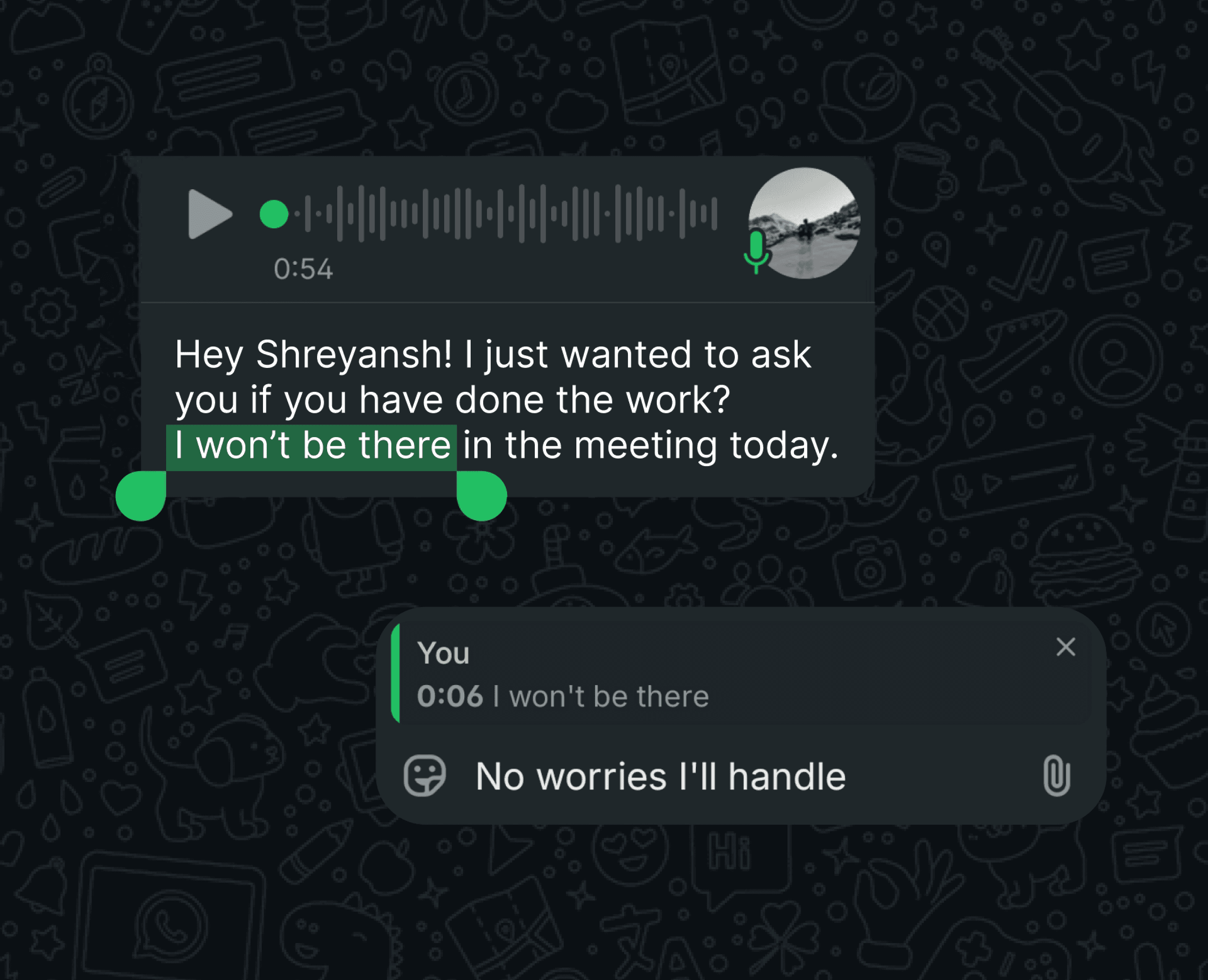
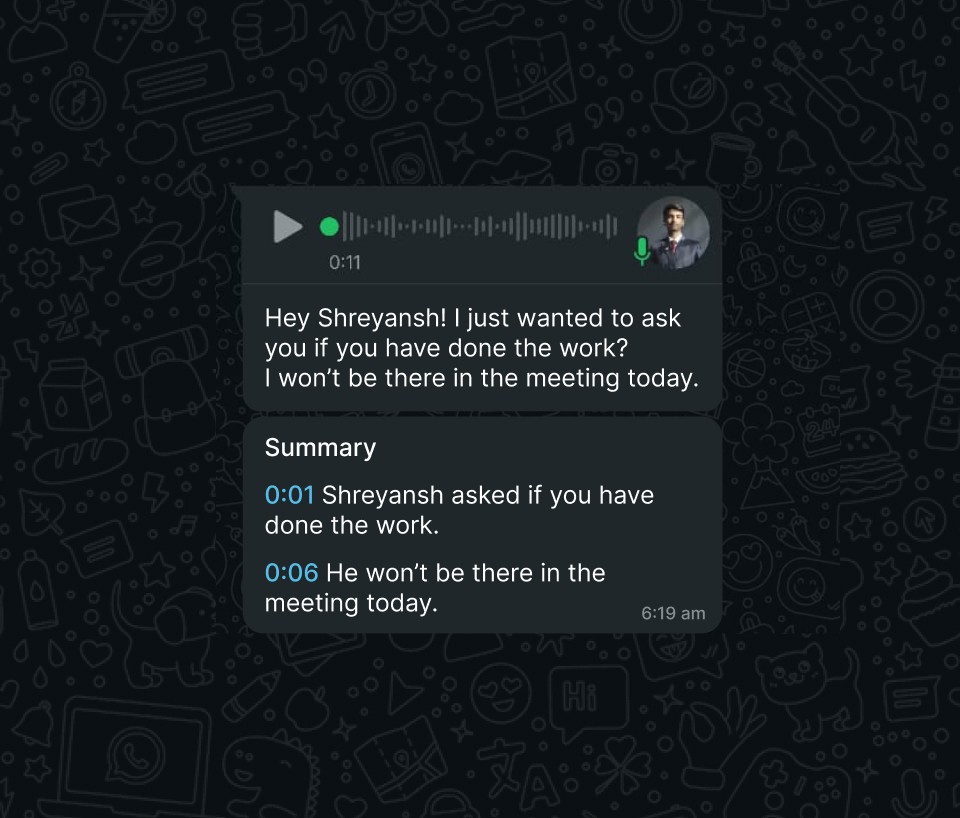
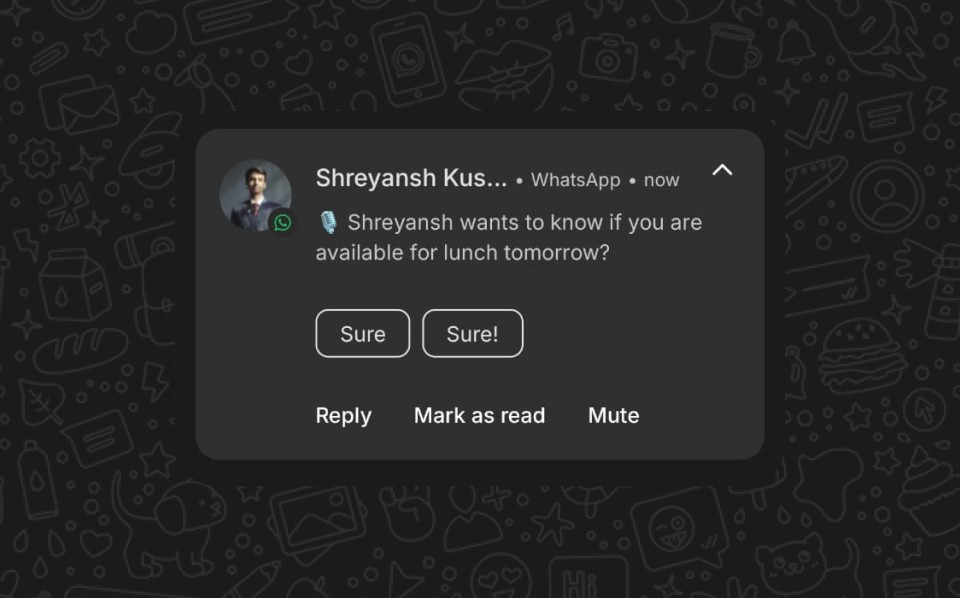
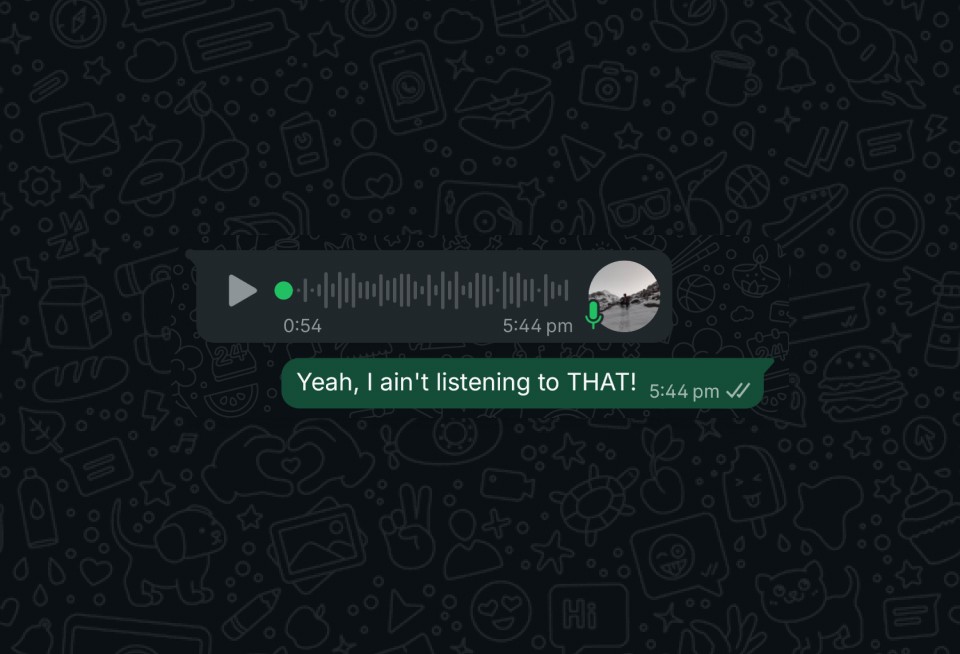
The prototype was built natively inside WhatsApp's existing design system in Figma, so every change had to feel like it already belonged. A contextual bottom sheet surfaces Transcribe and Summarise at the exact moment a voice note is played — no onboarding, no announcement, just a quiet signal closing the awareness gap. Dual-modality playback syncs text highlighting to audio in real time for split-attention environments. Time-linked replies let users respond to a specific timestamp, borrowing from YouTube's comment model rather than inventing a new one. Structured chapter summaries break long voice notes into timestamped chunks, directly resolving findability. Contextual notifications replace "You received a voice note" with a short text preview, closing context-blindness before the app even opens. And per-chat transcription settings follow the disappearing messages pattern: individual preferences, already understood, applied somewhere new.

05.
Testing it honestly
the result
A SUS evaluation across 14 participants returned a score of 79.1. Anything above 68 is considered above average usability. 79.1 sits in the "Good" range, close to the "Excellent" threshold. For a prototype built inside an existing product's design system without native implementation, that was a meaningful signal that the direction resonated.
The honest caveat: the sample was almost entirely students aged 18 to 24, highly tech-literate, predominantly urban. The findings hold within that demographic. But the framing would shift with older users, lower-bandwidth environments, or users for whom voice notes are a primary mode of communication rather than an occasional feature. That's the next study.